

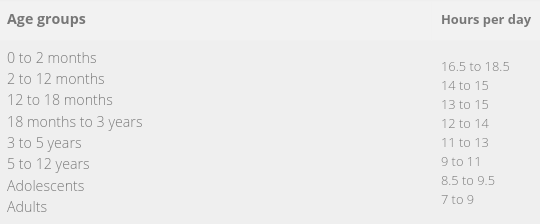
There is no specific standard for the ideal number of hours a person should sleep. It depends on the age, degree of activity and constitution of each person. Most adults need about eight hours of sleep. But some are satisfied with less than seven hours and remain fully functional. Others need a minimum of nine hours to function properly. However, according to sleep specialist Julie Carrier, people who sleep for only six hours and do not experience drowsiness symptoms during the day are extremely rare.
How do we know if we’ve slept enough?
According to specialists at the American Sleep Foundation, getting enough sleep simply means being able to function until the end of the next day, without feeling drowsy. Charles Morin, an expert on sleep problems, gives the following example in his book Winning the Enemies of Sleep: “Usually, a well-rested person will remain vigilant, even in an overheated room while listening to an uninteresting lecture after a hearty meal. “Another clue: if, in the morning, you tend to press the alarm reminder button on your alarm clock (snooze), you probably haven’t slept enough. Another way to know your natural sleep needs is to calculate your average length of sleep during the second week of your annual vacation. For most people, this would be more than the usual duration….
Can we sleep too much?
According to Julie Carrier, no study has shown that sleeping regularly for long nights could have any negative consequences. However, for several years, statistics have shown that sleeping little (less than seven hours) or a lot (more than eight hours) would be associated with a reduction in life expectancy. However, recent studies suggest that it is not really the fact of sleeping for a long time that is at issue. Rather, they are other factors that seem to be shared by people who sleep for a long time, such as fragmented sleep, increased fatigue, immune weakness, depressive tendencies or the prevalence of certain diseases. A person who sleeps long hours should therefore not try to shorten his or her sleep hours, but simply take the best possible care of his or her health,” concludes Julie Carrier.
Early bird or night bird?
It now seems to be a given that the fact of having a tendency to be an early riser or a night owl would be embedded in the genes and linked to circadian rhythms. These rhythms are directly dependent on the internal biological clock. It is possible, but only to a certain extent, to adjust one’s biological clock according to life’s constraints, such as the arrival of a child or a new work schedule. Light therapy and melatonin, the sleep hormone, can be used (see Night work and jet lag: when sleep is disrupted). But it is rare that people who naturally tend to be active and alert in the morning become real night birds. And vice versa. It is also good to know that the biological clock tends to change during adolescence. It is therefore normal for adolescents to want to go to bed later and stay in bed longer in the morning. It would be a biological question, not just a whim or the desire to continue the celebration…. In this context, various groups, particularly in the United States, are requesting that classes start later in the morning in order to respect the normal circadian rhythm of adolescents.
 Iron Health